
Blocks
One section per family / decor set (concept §4.2), filled in by the family issues.
Relic cache and relic artifact
Data preservation: nothing from the old world disappears silently.
- Relic cache (
 tinfoil:relic_cache
Items: stacks whose item still exists are upgraded from 1.20.1 with Minecraft's data fixers (enchantments, damage, names survive); the rest become relic artifacts. - Relic artifact (
 tinfoil:relic_artifact
"; F3+H shows the tag count and data version). /tinfoil relic inspect(look at a cache or hold an artifact) prints the stored origin;/tinfoil relic list [chunkRadius]counts caches in loaded chunks.
Block-entity format written by the porter (porter remap)
{ id: "tinfoil:relic_cache",
  tinfoil_origin: { id: "ironchests:iron_chest", state: "ironchests:iron_chest[facing=north]",
                    data: { …original block-entity NBT, incl. Items… }, data_version: 3465 } }
The block itself is x, y, z are set; data is the untouched 1.20.1 NBT (id, position and Items included). A cache is written for every block_entities.csv whose BE carries something (items, text, fluids, owners; bare numbers don't count), for converts the porter can't express (e.g. iron chests with contents, stoves with more than three stacks, paintings that would overlap), and for kept BEs whose block the table maps to air or a Tinfoil block.
Relic artifacts written by the porter
Items that items.csv maps to
- 1.20.1 stacks (vanilla containers, entities, player data; the DataFixer upgrades them on load):
{id: "tinfoil:relic_artifact", Count: n, tag: {tinfoil_origin: {id, state: "", data: <original stack NBT>, data_version: 3465}}}. The DataFixer moves the unknowntagintominecraft:custom_data, so the mod convertscustom_data.tinfoil_origininto thetinfoil:relic_origincomponent (RelicArtifactItem.migrate, done; was a follow-up inmod/). - 1.21 stacks (modded containers the DataFixer skips, e.g.
handcrafted:container):{id: "tinfoil:relic_artifact", count: n, components: {"tinfoil:relic_origin": {id, state: "", data, data_version: 3465}}}.
Block families
Generated from porter/mappings/tinfoil_blocks.csv (the porter decides what exists). Textures: tools/art/stone-textures.mjs, tools/art/material-textures.mjs; sheets in docs/art/MOODBOARD.md. Every block has a recipe: one crafting entry per family from vanilla materials, the rest from the stonecutter (slabs ×2).
| family | blocks | replaces (blocks in the transfer zones) |
|---|---|---|
| ancient_shingles | | 1,702 |
| atlantean_marble | | 9,162 |
| bermuda_stone | | 4,857 |
| crop_circle_mosaic | | 6,395 |
| crop_thatch | | 2,549 |
| gantry | | 1,113 |
| hangar_alloy | | 1,526 |
| herringbone_stone | | 582 |
| ley_tiles | | 207 |
| megalith_limestone | | 2,976 |
| polygonal_masonry | | 54 |
| pyramid_sandstone | | 12,310 |
| tartarian_brick | | 20,274 |
| tunguska_brick | | 10,211 |
 ancient_shingle_slab
 ancient_shingle_stairs
 ancient_shingles
 atlantean_marble
 atlantean_marble_brick_slab
 atlantean_marble_brick_stairs
 atlantean_marble_brick_wall
 atlantean_marble_bricks
 atlantean_marble_button
 atlantean_marble_lines
 atlantean_marble_pillar
 atlantean_marble_slab
 atlantean_marble_stairs
 atlantean_marble_tile_wall
 atlantean_marble_tiles
 atlantean_marble_wall
 chiseled_atlantean_marble
 chiseled_atlantean_marble_pillar
 polished_atlantean_marble
 polished_atlantean_marble_slab
 polished_atlantean_marble_stairs
 small_atlantean_marble_brick_stairs
 small_atlantean_marble_bricks
 bermuda_stone
 bermuda_stone_brick_stairs
 bermuda_stone_bricks
 bermuda_stone_button
 bermuda_stone_lines
 bermuda_stone_pillar
 bermuda_stone_slab
 bermuda_stone_stairs
 bermuda_stone_tile_slab
 bermuda_stone_tile_stairs
 bermuda_stone_tiles
 bermuda_stone_wall
 chiseled_bermuda_stone
 polished_bermuda_stone
 small_bermuda_stone_brick_slab
 small_bermuda_stone_bricks
 acacia_crop_circle_mosaic
 acacia_crop_circle_mosaic_slab
 birch_crop_circle_mosaic
 birch_crop_circle_mosaic_slab
 blue_crop_circle_mosaic
 blue_crop_circle_mosaic_slab
 brown_crop_circle_mosaic
 brown_crop_circle_mosaic_slab
 cherry_crop_circle_mosaic
 cherry_crop_circle_mosaic_slab
 green_crop_circle_mosaic
 green_crop_circle_mosaic_slab
 jungle_crop_circle_mosaic
 jungle_crop_circle_mosaic_slab
 oak_crop_circle_mosaic
 oak_crop_circle_mosaic_slab
 red_crop_circle_mosaic
 red_crop_circle_mosaic_slab
 white_crop_circle_mosaic
 white_crop_circle_mosaic_slab
 yellow_crop_circle_mosaic
 yellow_crop_circle_mosaic_slab
 crop_circle_bale
 crop_thatch
 crop_thatch_slab
 gantry_mesh_fence
 hangar_alloy
 hangar_alloy_casing
 hangar_alloy_plating
 hangar_alloy_slab
 hangar_alloy_stairs
 hangar_tarmac
 olive_hangar_tarmac
 olive_hangar_tarmac_slab
 dark_herringbone_stone
 herringbone_stone
 chiseled_ley_tiles
 chiseled_megalith_limestone
 megalith_limestone
 megalith_limestone_bricks
 megalith_limestone_lines
 megalith_limestone_pillar
 megalith_limestone_stairs
 megalith_limestone_tile_slab
 megalith_limestone_tile_wall
 megalith_limestone_tiles
 megalith_limestone_wall
 polished_megalith_limestone
 polished_megalith_limestone_slab
 polished_megalith_limestone_stairs
 small_megalith_limestone_brick_stairs
 small_megalith_limestone_brick_wall
 small_megalith_limestone_bricks
 polygonal_masonry
 pyramid_sandstone_brick_slab
 pyramid_sandstone_brick_stairs
 pyramid_sandstone_brick_wall
 pyramid_sandstone_bricks
 pyramid_sandstone_pillar
 small_pyramid_sandstone_brick_slab
 small_pyramid_sandstone_brick_stairs
 small_pyramid_sandstone_brick_wall
 small_pyramid_sandstone_bricks
 cracked_tartarian_bricks
 mixed_tartarian_bricks
 mossy_tartarian_brick_slab
 mossy_tartarian_brick_stairs
 mossy_tartarian_bricks
 tartarian_brick_pillar
 tartarian_brick_slab
 tartarian_brick_stairs
 tartarian_brick_wall
 tartarian_bricks
 chiseled_tunguska_brick
 cracked_tunguska_brick_stairs
 cracked_tunguska_brick_wall
 cracked_tunguska_bricks
 dark_tunguska_brick_pillar
 polished_tunguska_brick
 polished_tunguska_brick_button
 polished_tunguska_brick_slab
 polished_tunguska_brick_stairs
 tunguska_brick_pillar
 tunguska_brick_slab
 tunguska_brick_stairs
 tunguska_brick_wall
 tunguska_bricks
Shapes: cube, pillar, slab, stairs, wall, button, pane ( gantry_bars
 tartarian_column
 gantry_support
 timber_support
 gantry_railing
Decor
34 pieces, one Blockbench model each (art/blockbench/), facing the player, waterloggable, all from the stonecutter (cut from the material they're carved or cast from):
| set | pieces |
|---|---|
| Bunker & temple furniture | agency chair, agency desk, saucer parasol (light 10), temple trellis |
| Out-of-place artifacts | amphora, amphora rack, crystal skull, gear mechanism, glyph decal, ley spout, offering bowl, star map tablet, weather balloon crate |
| Ley lights | hazard lamp (13), ley brazier (15), ley lamp (15), sandstone/stone glyph lanterns (12), signal lantern (12), tall ley torch (15) |
| Effigies & cryptids | bigfoot, grey visitor, lake serpent, lizard, moai, mothman (red eyes glow), stone sphere |
| Ancient maglev | maglev track (glowing rails) |
| Dormant devices | antenna array, dormant machine, monolith terminal, numbers station radio, specimen tank, tesla coil |
Ruin & anomaly pieces
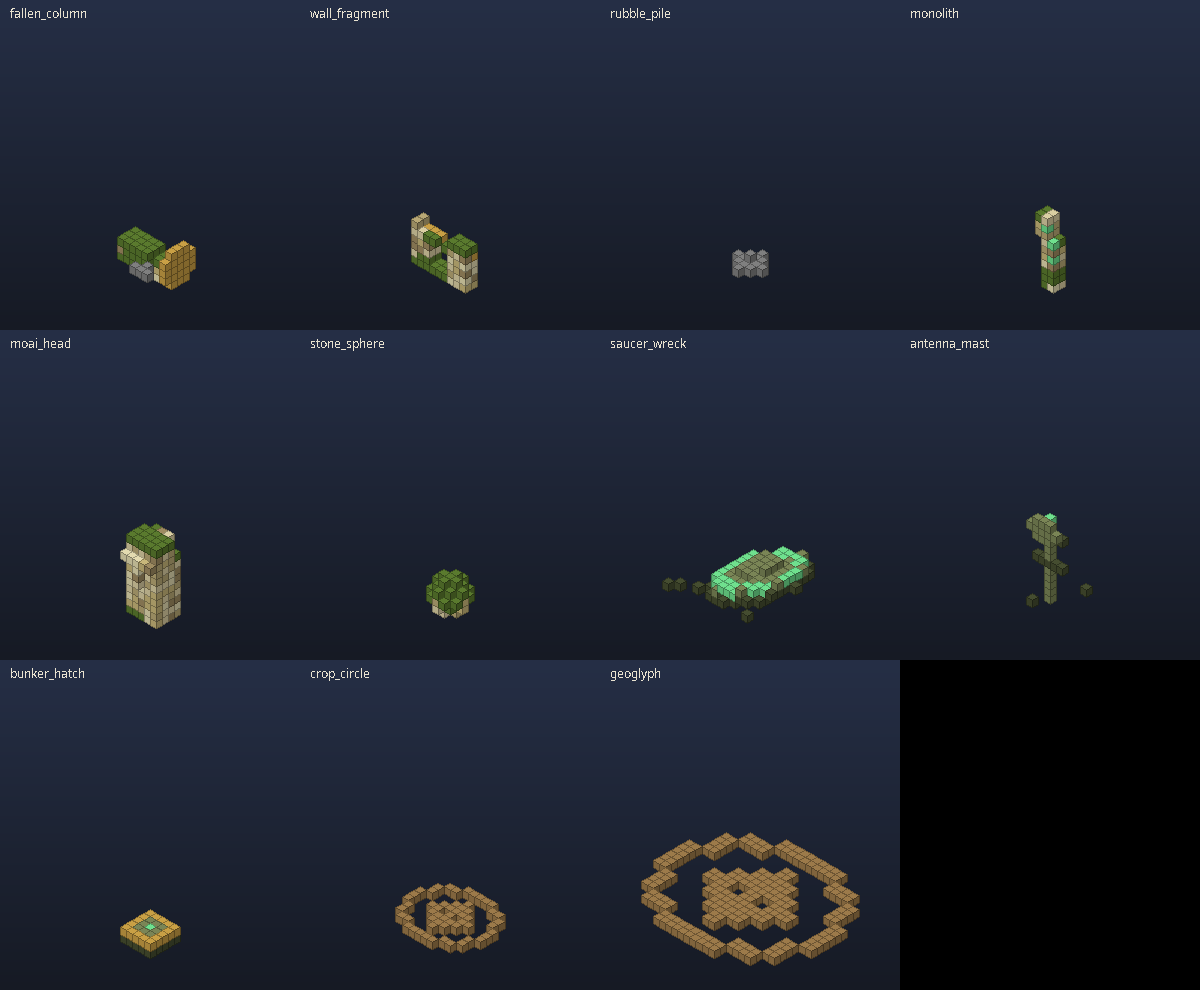
Procedural and deterministic in a seed (logic/ruin/RuinBuilder), placed by the fold passes, the native Ancient Islands and /tinfoil ruin place <piece> [scheme] [seed]:
fallen column · wall fragment (ragged top, trapezoid doorway, glyph band) · rubble pile · half-buried monolith (glow line) · moai head (buried to the chin) · stone sphere · saucer wreck (tilted, glowing ring, scattered plates) · antenna mast · bunker hatch · crop circle · geoglyph.
- Materials: ruin schemes in
data/<ns>/tinfoil/ruin_schemes/*.json(statue-scheme format plus optionalmetal,metal_dark, rubble
mark): atlantean, bermuda, megalith, pyramid, tartarian, hangar wreck, crop circle, geoglyph. - Patterns:
data/<ns>/tinfoil/patterns/*.json{kind: crop_circle|geoglyph, rows: ["..#.."]}; our own designs. - Crop circles and geoglyphs only press into natural ground (dirt, grass, sand, farmland, terracotta, gravel) and clear the plants above; they never cut into builds or water.
- New block: Rubble (1–8 layers like snow, never melts; 8 from cobblestone in the stonecutter).
Conspiracy board
A cork board that hangs on a wall (place it against one). Right-click with an item to pin it in the quadrant you clicked (one item; it's shown flat on the cork); an empty hand takes it back. Use string on a pinned slot, then on another pinned slot up to 16 blocks away (same or another board): a red string connects them. Unpinning cuts the strings of that slot. Two boards from 8 sticks around a plank. The renderer (items + strings) is client-side and was checked only by compiling; look at it in the dry run.